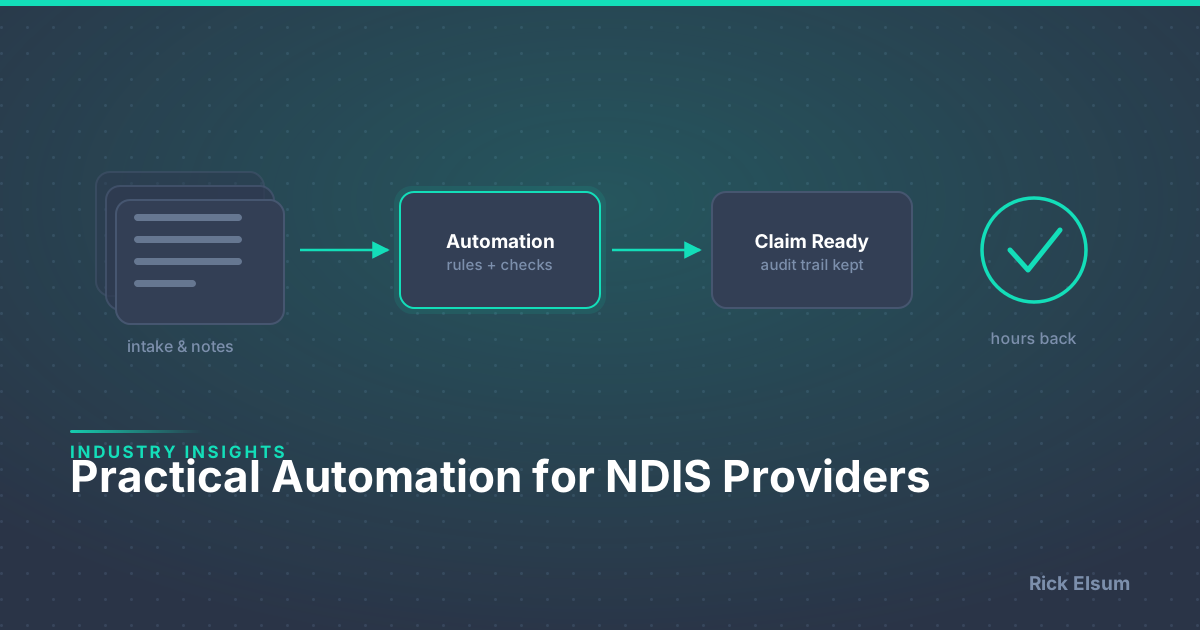
A Practical Guide to Automation for NDIS Providers
NDIS providers face a unique challenge: the people who need help most are often the ones you have the least time to help because of administrative overhead.
The NDIS Admin Burden
Average time spent per participant per week on:
- Service agreements & plans: 2-3 hours
- Progress notes & documentation: 4-5 hours
- Invoicing & claiming: 1-2 hours
- Compliance reporting: 2-3 hours
- Appointment scheduling: 1-2 hours
Total: 10-15 hours per participant per week on admin.
For a provider supporting 50 participants, that's 625 hours per week just on paperwork.
What Can Be Automated?
1. Client Intake & Eligibility
Manual Process:
- Participant fills out paper forms
- Staff manually enter data into system
- Manually check NDIS plan details
- Schedule assessment appointment
Time: 2-3 hours per new participant
Automated Process:
- Online intake form with smart validation
- AI extracts data from NDIS plans automatically
- System flags urgent cases immediately
- Participant file created with all documents attached
Time: 15 minutes (just to review and approve)
Savings: 85% reduction, help more people faster
2. Clinical Documentation
Manual Process:
- Therapist sees participant
- Later, therapist writes session notes
- Reviews previous notes manually
- Updates treatment plan
Time: 30-45 minutes per session
Automated Process:
- AI converts session recording to structured notes
- Automatically links to treatment goals
- Flags items requiring therapist review
- Updates progress tracking automatically
Time: 5-10 minutes (just to review and approve)
Savings: 70% reduction, 10-15 hours per therapist per week
3. NDIS Claiming & Invoicing
Manual Process:
- Review service delivery for the week
- Match services to NDIS plan categories
- Calculate pricing based on NDIS rules
- Submit claims to portal
- Track payments and follow up on rejections
Time: 4-6 hours per week
Automated Process:
- Services automatically categorized as delivered
- Pricing calculated using current NDIS schedule
- Claims submitted to NDIS portal automatically
- Rejection alerts with resolution suggestions
Time: 30 minutes (just to review exceptions)
Savings: 90% reduction, faster payments
4. Compliance Reporting
Manual Process:
- Gather data from multiple systems
- Calculate metrics manually
- Create reports in Word/Excel
- Submit to NDIS Quality and Safeguards Commission
Time: 2-3 days per quarter
Automated Process:
- Data aggregated automatically
- Reports generated with current metrics
- Compliance issues flagged proactively
- One-click submission with audit trail
Time: 1-2 hours (just to review before submission)
Savings: 85% reduction, no missed deadlines
Privacy & Security Requirements
NDIS providers MUST protect participant data. This means:
What NOT to Do:
❌ Don't use ChatGPT or cloud AI for clinical notes
❌ Don't store participant data in public cloud without encryption
❌ Don't use generic automation tools that send data overseas
What to Do Instead:
✅ Use on-premises or Australian-hosted systems
✅ Ensure end-to-end encryption for all participant data
✅ Maintain complete audit trails
✅ Keep AI processing on your own servers
Private automation means automation that keeps participant data under your complete control.
ROI for NDIS Providers
Small Provider (20 participants)
Current costs:
- 250 admin hours/week
- 3 full-time admin staff
- Cost: ~$180,000/year
With automation:
- 75 admin hours/week
- 1 full-time admin staff
- Cost: ~$60,000/year + $20,000 automation
- Net savings: ~$100,000/year
Bonus: Can serve 30-40% more participants with same team
Medium Provider (100 participants)
Current costs:
- 1,250 admin hours/week
- 15 admin staff
- Cost: ~$900,000/year
With automation:
- 375 admin hours/week
- 5 admin staff
- Cost: ~$300,000/year + $50,000 automation
- Net savings: ~$550,000/year
Bonus: Can serve 2x participants with same overhead
Implementation Roadmap
Phase 1: Quick Wins (Month 1-2)
- Automated appointment reminders
- Digital intake forms
- Automated invoicing
- Expected impact: 20-30% admin time reduction
Phase 2: Core Automation (Month 3-4)
- Clinical note assistance
- NDIS claiming automation
- Document management
- Expected impact: 50-60% admin time reduction
Phase 3: Advanced Intelligence (Month 5-6)
- Predictive scheduling
- Outcome tracking
- Compliance monitoring
- Expected impact: 70-80% admin time reduction
What About Staff?
Common fear: "Will automation eliminate jobs?"
Reality: Automation eliminates tasks, not jobs. Your staff shifts from:
❌ Data entry
❌ Copying information between systems
To:
✅ Direct participant support
✅ Complex case management
✅ Quality improvement
✅ Growing your service capacity
Choosing the Right Solution
Questions to ask potential automation providers:
- Where is participant data stored? (Should be Australia)
- Who can access our data? (Should be only you)
- How is data encrypted? (Should be end-to-end)
- What audit trails exist? (Should be comprehensive)
- Is it NDIS Practice Standards compliant? (Must be yes)
- Can you customize to our workflows? (Should be yes)
- What training and support is included? (Should be ongoing)
The Bottom Line
NDIS providers exist to help participants live their best lives. Every hour spent on paperwork is an hour not spent doing that.
Automation isn't about replacing the human touch—it's about freeing your team to provide it.
Ready to reduce admin burden and serve more participants? Let's discuss your specific needs.