Why Polyglot Programming Matters for Your Business
You wouldn't use a hammer to drive in a screw. So why do some development shops try to build everything with just one programming language?
What is Polyglot Programming?
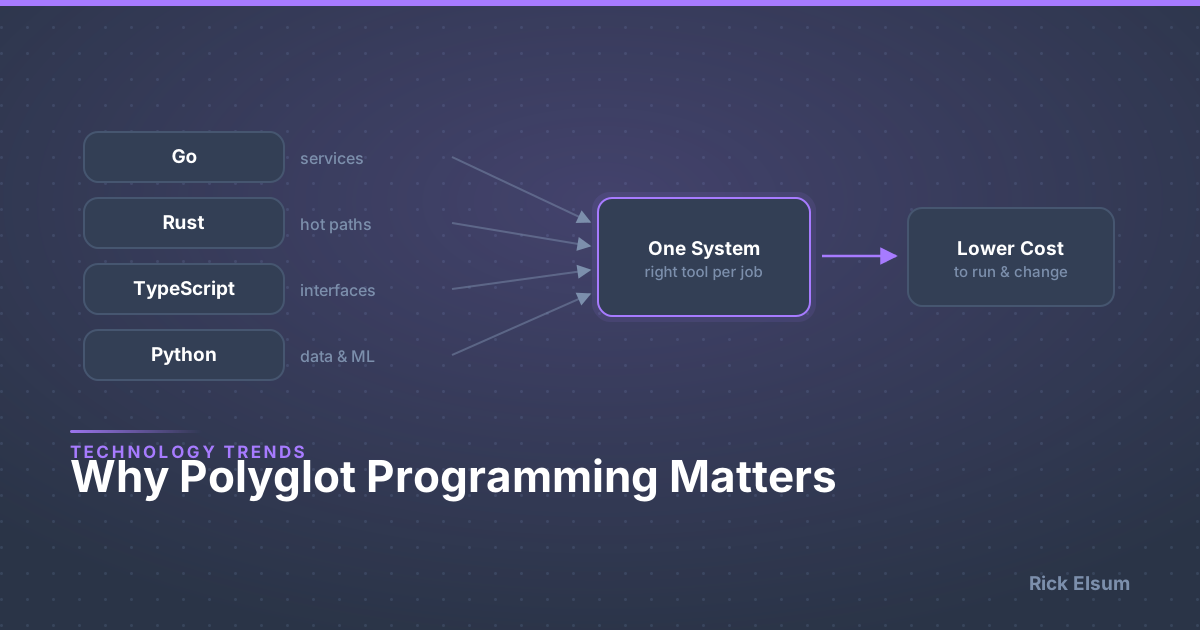
Polyglot programming means using multiple programming languages within a single project—choosing the best tool for each specific task.
At 1 Source Systems, we're fluent in:
- Rust - High-performance, secure systems
- Go - Scalable backend services
- Python - AI/ML and data processing
- TypeScript - Modern web applications
- Solidity - Blockchain smart contracts
Why This Matters to Your Business
1. Faster Development
Different languages excel at different tasks:
- Python can build an AI model in days that would take weeks in Java
- Go creates microservices with half the code of equivalent Java services
- Rust ensures memory safety at compile-time, eliminating entire classes of bugs
- TypeScript catches errors before deployment, reducing testing time
Translation: Your project launches faster and costs less.
2. Better Performance
Language choice directly impacts your infrastructure costs:
A Rust service can handle 10x more requests per server than equivalent Python code. That means:
- Fewer servers needed
- Lower hosting costs
- Better user experience
- Reduced environmental impact
Real example: We rebuilt a client's Python API in Rust. Result: 80% reduction in server costs, 5x faster response times.
3. Future-Proof Solutions
Technology trends shift. The hot framework of 2024 might be legacy code in 2027.
Polyglot teams can:
- Migrate to new technologies when beneficial
- Integrate with any third-party service
- Adopt new tools without rewriting everything
- Maintain systems as languages evolve
You're not locked into aging technology.
4. Access to Better Libraries
Each language has specialized libraries:
- Python: TensorFlow, PyTorch for AI
- JavaScript/TypeScript: React, Next.js for web apps
- Rust: Tokio for async processing
- Go: Kubernetes, Docker ecosystem
- Solidity: Ethereum smart contract ecosystem
Using the right language means accessing the best tools, not reinventing the wheel.
Real-World Application: Crypto Trading Platform
Here's how we used polyglot programming for a cryptocurrency client:
1. Rust - Core trading engine
- Why: Millisecond latency matters; memory safety is critical
- Result: Handles 100,000+ trades/second with zero memory leaks
2. Go - API services and microservices
- Why: Easy concurrency, fast compilation
- Result: Scales automatically with traffic spikes
3. Python - AI risk analysis
- Why: Rich ML libraries, rapid development
- Result: Sophisticated risk models deployed in weeks
4. TypeScript - User dashboard
- Why: Type safety, excellent React ecosystem
- Result: Responsive UI with catch-before-deployment error prevention
5. Solidity - DeFi integrations
- Why: Smart contract standard
- Result: Seamless blockchain interaction
Could this be built with just one language?
Technically yes. Practically no. It would be:
- 3x slower to develop
- 10x more expensive to run
- Harder to maintain
- Less secure
The Single-Language Trap
Many agencies push one-language solutions because:
- Limited expertise - They only know one language
- Easier staffing - Junior developers are cheaper
- Familiar territory - Less risk for them
But this limits YOU:
- Higher long-term costs - Inefficient solutions cost more to run
- Slower development - Wrong tools take longer
- Technical debt - Fighting the language creates messy code
- Vendor lock-in - Hard to find replacements who know their specific stack
How to Evaluate Development Partners
Red Flags:
- "We build everything in [single language]"
- "We have a standard stack we use for all projects"
- "Learning new languages isn't necessary"
Green Flags:
- "Let's discuss what technologies fit your specific needs"
- "We choose tools based on project requirements"
- "Here's why we'd use X for this component and Y for that one"
The Business Bottom Line
Polyglot programming means:
✅ 20-40% faster development (right tools for each job)
✅ 50-80% lower infrastructure costs (efficient code)
✅ Better security (languages with built-in safety)
✅ Future-proof architecture (not locked into one ecosystem)
✅ Access to latest innovations (any technology, any time)
It's Not About Technology, It's About Results
You don't need to understand the technical differences between Rust and Go. You need to know that your development partner:
- Chooses tools based on your business needs, not their comfort zone
- Optimizes for long-term value, not just initial development cost
- Builds systems that scale without massive infrastructure bills
- Delivers faster by using the right tool for each task
That's what polyglot programming gives you.
Want to discuss the right technology stack for your project? Get in touch.