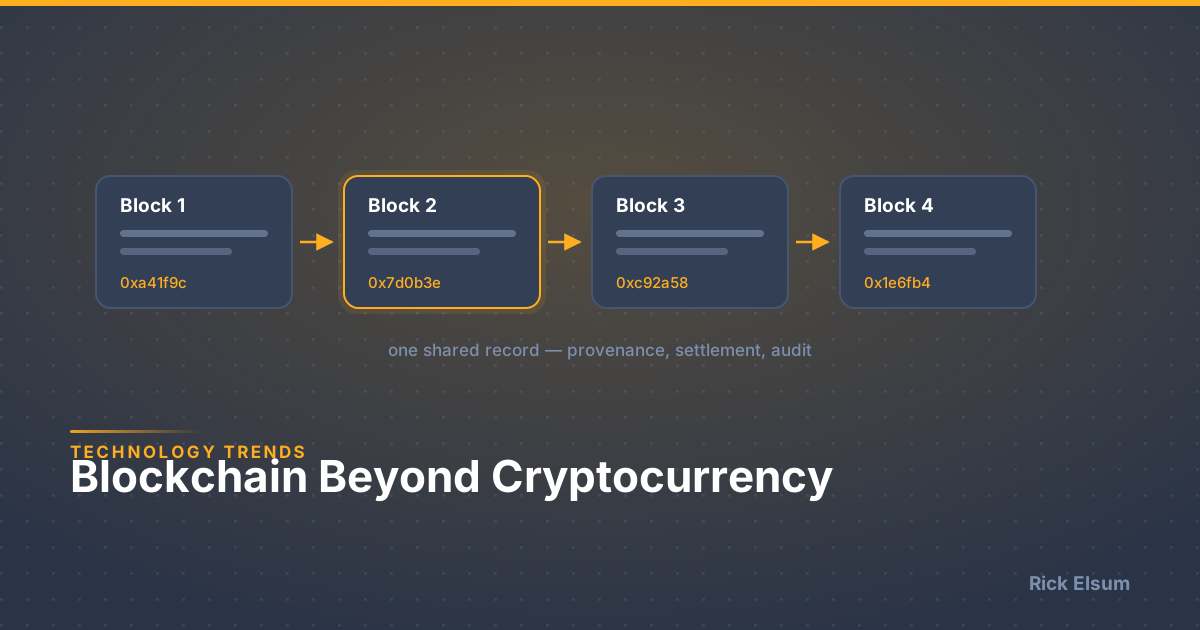
Blockchain Beyond Cryptocurrency: Real Business Applications
When most people hear "blockchain," they think Bitcoin. But the technology behind cryptocurrencies has applications far beyond digital money.
What Is Blockchain, Really?
Forget the hype. At its core, blockchain is:
A shared database where:
- Everyone has a copy
- No one can change past entries
- Everyone can verify what's true
- No central authority controls it
Think of it as a shared spreadsheet that no one can cheat.
Why This Matters for Business
The Trust Problem
Traditional business requires trust through intermediaries:
- Banking: Trust the bank to hold your money
- Contracts: Trust lawyers and courts to enforce agreements
- Supply chains: Trust each party to report honestly
- Records: Trust central databases aren't tampered with
Intermediaries are expensive, slow, and sometimes fail.
Blockchain enables trust through mathematics instead of intermediaries.
Real Business Use Cases
1. Supply Chain Transparency (Mining & Resources)
The Problem:
- Minerals pass through 5-10 companies from mine to manufacturer
- Each company has different records
- Impossible to verify origin or ethical sourcing
- Fraud is common
Blockchain Solution:
- Each transfer recorded on blockchain
- Cannot alter past records
- Customers scan code to see complete history
- Automatic verification of certifications
Real Example: Diamond companies use blockchain to prove stones aren't "blood diamonds." Each diamond gets a blockchain record from mine to retail, proving ethical sourcing.
Business Value:
- Premium pricing for verified ethical products
- Reduced fraud
- Instant auditing
- Customer trust
2. Smart Contracts (Legal & Finance)
The Problem:
- Traditional contracts require lawyers to enforce
- Disputes take months/years in court
- High legal costs
- Parties can violate terms before enforcement
Blockchain Solution:
- Contract terms coded as "smart contract"
- Executes automatically when conditions met
- No need for intermediaries
- Instant enforcement
Real Example: Insurance policy that automatically pays out when flight is delayed (verifiable data from airline). No claims process, no disputes, instant payment.
Business Value:
- 90% reduction in contract execution costs
- Instant settlement
- No payment disputes
- Automated compliance
3. Medical Records (Healthcare)
The Problem:
- Patient records scattered across multiple providers
- Can't easily share between hospitals
- Patients don't control their own data
- Privacy breaches common
Blockchain Solution:
- Patient owns their complete medical record
- Grants access to specific providers temporarily
- All access logged immutably
- Records can't be lost or altered
Business Value:
- Better patient care (complete history)
- HIPAA compliance easier
- Reduced duplicate testing
- Patient privacy protected
4. Digital Identity (Multiple Industries)
The Problem:
- Everyone wants username/password
- Data breaches expose credentials
- Identity theft is rampant
Blockchain Solution:
- One digital identity you control
- Prove who you are without revealing everything
- Can't be stolen (you hold private keys)
- Revoke access instantly if compromised
Real Example: Estonia runs entire national ID system on blockchain. Citizens use one digital ID for banking, voting, medical records, taxes—everything.
5. Intellectual Property (Legal & Creative)
Blockchain Solution:
- Register creative work on blockchain with timestamp
- Immutable proof of creation date and ownership
- Automated royalty distribution
- Easy licensing verification
Business Value:
- Protect your IP
- Automated payments
- Reduced legal costs
- Easier licensing
Technical Deep Dive: How Smart Contracts Work
Escrow Smart Contract Example
Traditional Process:
- Buyer pays escrow company (3-5% fee)
- Seller delivers goods
- Buyer confirms receipt
- Escrow releases payment (5-10 business days)
Smart Contract Process:
- IF buyer deposits funds
- AND seller ships item (confirmed by tracking)
- AND buyer doesn't dispute within 48 hours
- THEN automatically transfer funds to seller
Fee: 0.1% (not 3-5%) | Time: Instant | Trust required: None
Common Blockchain Misconceptions
"Blockchain is slow"
Old truth, new reality: Modern blockchains (Solana) handle 65,000 transactions/second. Speed is no longer an issue for most use cases.
"Blockchain wastes energy"
Partially true: Bitcoin's Proof-of-Work is energy intensive. But Ethereum's Proof-of-Stake uses 99.95% less energy. Choose the right consensus mechanism for your needs.
"It's too expensive"
Blockchain is often cheaper than traditional methods:
- Escrow: 0.1% vs 3-5%
- Wire transfers: $0.01-1.00 vs $25-50
- Smart contract execution: pennies vs $500-5,000 in legal fees
Implementation Considerations
When Blockchain Makes Sense:
- Multiple parties need to share data
- Trust is expensive (intermediaries, verification)
- Audit trails are important
- Automation can replace manual processes
- Immutability adds value
When It Doesn't:
- Single organization, no need to share
- Central authority is trusted and efficient
- Data needs to be editable/deletable
ROI Calculation Example
Supply Chain Tracking (Mining Company)
Current costs (Traditional):
- Manual verification: $500K/year
- Fraud losses: $2M/year
- Audit costs: $300K/year
- Total: $2.8M/year
Blockchain implementation:
- Development: $400K one-time
- Annual operation: $100K/year
- Fraud reduction: 90% ($1.8M saved)
- Audit automation: 80% ($240K saved)
- Net first-year savings: $1.64M
- ROI: 410% in year one
The Bottom Line
Blockchain isn't magic, but it's powerful for specific problems:
✅ Multiple parties sharing data
✅ Trust is expensive to establish
✅ Transparency creates value
✅ Automation can replace intermediaries
✅ Immutable records are important
If your business faces these challenges, blockchain might be the solution you need.
Curious if blockchain can solve your business challenges? Let's explore your use case.